Tag Archives: Hiking

Kilimanjaro – Marangu Route

For most Kenya outdoor enthusiasts, the ultimate is to summit Mt. Kilimanjaro. Many people considering trekking Kilimanjaro ask what the best route is. “Best” can mean anything. But perhaps most people asking this question mean which route guarantees success.

Marangu route should be the easiest route to the summit of Mt. Kilimanjaro. But it has the worst success rate because climbers are least prepared. The Marangu route takes you at a gentle pace through rain forests, moorlands and the alpine desert at the saddle between Kibo and Mawenzi.

To ensure success summiting Kilimanjaro, one needs to anticipate the difficulties and make plans to surmount them.
These are:
1. General fitness
2. Endurances fitness.
3. Altitude

1. General fitness: Establish that the body is fit enough to withstand sub-zero temperatures and other vagaries of outdoor living for five to six days. It is also important to note the bod’s ability to adabt to abrupt change of diet. Hand in hand to this is the mental attitude and willingness to go through it.

2. Endurance fitness: In general the body should be able to withstand four contiguous days of uphill walking for five to six hours daily while carrying about six Kilograms of gear. This calls for strict regimes of exercises that can be done in the house, field or gym, such as cardio, squats, jogging, treadmill or skipping rope.

3. Altitude: Hiking and trekking at least once every two months preferably in altitudes over of 2500 metres e.g. Ngong hills, Longonot, Oldonyo sabuk, Kinari forest, Elephant hill, Kipipiri, mount Kenya (preferably to Leanna point) will give the body the much needed acclimatisation.
It is important to deliberately choose at least one wet season hike in order to test rain gear.

Below is a list of items that one needs to collect and test in advance in order to make the climb as friendly as possible.
I have used the key below to rate the items

Key
**** Crucial to have
*** Important to have
** Good to have
* luxury

ITEM Description QTY Cost (Ksh) Total cost(Ksh)

Clothing

Rain coat or poncho with hood**** Waterproof enough to keep off heavy rain 1 7,000.00 7,000.00
Warm jacket**** Water resistant and breathable- can be made of down, thinsulate or fleece. Down and fleece dry much faster than wool 1 15,000.00 15,000.00
Long Sleeve thermal vest*** 3 2,000.00 6,000.00
Short Sleeve Shirt, light-weight, moisture-wicking fabric 5 2,000.00 10,000.00
Waterproof trousers, breathable (side-zipper recommended)*** 1 8,000.00 8,000.00
Hiking Pants (convertible to shorts recommended)**** 1 9,000.00 9,000.00
Long Underwear (moisture-wicking fabric recommended) 2 2,000.00 4,000.00
Underwear (boxers or briefs)*** moisture-wicking fabric recommended
choose something that allows you to change in the presence of women
3
Gloves, warm (waterproof recommended)**** 1 1,000.00 1,000.00
Brimmed Hat, baseball cap for sun protection*** 1 500.00 500.00
Warm Head wear**** Fleece or woollen cap. If you choose one that covers the sides and neck then you don’t need the balaclava and scarf 1 1,000.00 1,000.00
Balaclava or scarf** 1
Hiking Boots**** High cut, warm, waterproof, broken-in, half or one size larger to allow wearing excess socks. 1 15,000.00 15,000.00
Gym shoes, trainers or sneakers*** To wear at camp 1 4,000.00 4,000.00
Socks**** Thick, woollen or fleece. You might want to get a pair to use when testing boots 6 200.00 1,200.00
Gaiters** Effective in keeping water, pebbles out of your shoes and the lases in place 1 1,500.00 1,500.00

Equipment

Sleeping Bag*** rated +10 to +35 0F.
Go for mummy type (with hood) as opposed to rectangular because it fits close to the body leaving less chance for cold spots.
1 7,000.00 7,000.00
Head lamp, with extra batteries**** for summit night 1
Rucksack*** Enough for porters to carry your equipment in. Kili porters are allowed to carry only 15 Kg of your gear. Line it with garbage bags for extra water resistance. Use stuff bags to separate things e.g. socks and underwear, sleeping bag, toiletries, T-shirts, rainwear, used clothes etc. 1 5,000.00 5,000.00
Backpack**** with waterproof cover for you to carry items you may require during the day and delicate items like electronics and glass. 1 5,000.00 5,000.00
Sunglasses or Goggles*** Snow blindness can be catastrophic after Gilman’s point. Test glasses that you can wear on your spectacles 1
Vacuum flask* To carry hot water to use after 5000 metres 1
Camel-back water pouch*** Two litres capacity. Your potter can carry the extra water 1 2,000.00 2,000.00
Small Towel*** lightweight, quick-dry 1
Stuff bags* to keep gear dry and separate e.g. a pouch each for shoes, socks and underwear, sleeping bag, wet towels, garbage, T-shirts, rainwear, used clothes etc. 5 200.00 1,000.00
Other
Toiletries****
Prescriptions***
Sunscreen***
Lip Balm***
Hand Sanitizer***
Toilet Paper***
Wet Wipes***
Snacks, light-weight, high calorie, high energy (optional)***
WC liner*
Pencil and Notebook, miniature, for trip log (optional)*
Camera, with extra batteries*
Power bank* from 10000mAh. Keep devices in Aeroplane mode to conserver power. 1 10,000.00 10,000.00
Book reader/ePad*
Board game (if in a group)*
Cost
The direct cost of the trip from Nairobi are as follows
To JKIA and back 1 10,000.00 10,000.00
JKI-JRO return ticket 1 40,000.00 40,000.00
JRO-Moshi and back 1 9,000.00 9,000.00
Trip Charges covers hotel accommodation, accommodation on the mountain, porters salaries, food, travel to the park gate 1 40,000.00 40,000.00
Tips for sharing with your climb partners per the whole trip.
– Support Crew sh300-sh400
– Cook sh600-sh800
– Chief Guide/guide sh1,000-sh1500
– assist Guide sh600-sh800
1 4,000.00 4,000.00
Statutory Requirements
Passport
Yellow fever Papers
For prep hikes https://www.facebook.com/groups/hikerske/
https://www.facebook.com/groups/123821337675197/
For hiking gear www.nairobisportshouse.com
www.kingscollection.co.ke
http://www.sportsdirect.com/
https://www.thenorthface.com/
https://www.jumia.co.ke
http://www.yaya-centre.com/?portfolio=extreme-outdoors

3 day Karuru waterfall

3 day Karuru waterfall.

Location Aberdares
Starting Point Kahuruko forest gate
Ending point Kahuruko forest gate
Walking Duration 3 days
Terrain Motorable road or mashes
Difficulty Easy
Elevation gain 600m and 300m

The objective of the hiker is to spend 3 days exploring the western side the Aberdare mountain range. This hike may be suititable for anyone wishing to acclamatise for a mt. Kenya or Mt. Kilimanjaro trek.

Day 1. The hike starts from the forest gate at Kahuruko. After zipping boots, you take the tarmac road going up to the park gate. You walk the afforested part of the KFS managed forest that rapidly gives way to thick bamboo. The road gets lonely and treacherous as meadre through it climbing steadily from 2600 metres asl to 3200 metres asl.
Pitch camp at the part gate for overnight stay.

Day 2: From the Mutubio park gate whence you walk down a motororableroad for half a kilometre then turn right into the moorland. You descend gently towards the catchment of the tributary to the karuru river and walk along the edges following animal trails till you get to the road.

Once you get to the road, walk along it until you get to the campsite. After a short rest you walk down a steep path, across the bridges with crystal clear water and up to the view point.

The other alternative is to walk along the motorable road from the gate until you get to the first turning to the right. Take this right turn, then walk along it to the campsite and onwards to the view point.

Then you walk back to the park gate for over night stay

Day 3: You start early morning to descend the 10 kms to the forest gate.

Guiding
KWS rangers

Fee
Standard KWS park fees
Standard KWS rangers fees

Getting there
Public means:
Take matatus to Kahuruko

Karuru waterfall.

Location Aberdares
Starting Point Mutubio park gate
Ending point Mutubio park gate
Walking Duration 8 hours
Terrain Motorable road or mashes
Difficulty Moderate
Elevation gain  300m

Karuru waterfall

The objective of the hiker is to get to the waterfall overlooking the spectacular Karuru falls and back to mutubio.

The hike starts from the mutubio park gate whence you walk down a motororableroad for half a kilometre then turn right into the moorland. You descend gently towards the catchment of the tributary to the karuru river and walk along the edges following animal trails till you get to the road.

Once you get to the road, walk along it until you get to the campsite. After a short rest you walk down a steep path, across the bridges with crystal clear water and up to the view point.

The other alternative is to walk along the motorable road from the gate until you get to the first turning to the right. Take this right turn, then walk along it to the campsite and onwards to the view point.

Guiding
KWS rangers

Fee
Standard KWS park fees
Standard KWS rangers fees

Getting there
Public means:
Take matatus to Ndunyu-njeru and hire a taxi to the Mutubio park gate.

Private means:
From Ndunyu njeru drive through the earth road up to the forest gate. Then meadre your way into the thick bamboo forest. The road through the forest is tarmacked for the rest of the uphill 10 km journey to the park gate.

.

Ololosukuan (Savannah Sunset Resort)

Location Kibiko, Ngong
Starting Point Savannah sunset resort
Ending point Savannah sunset resort
Walking Duration 1 hour
Terrain Rocky
Difficulty Very Easy
Elevation gain

The purpose of this hike is to spend an hour or so enjoying the natural habitat of the private conservancy.

Outdoor enthusiast will find Ololosukuan, also called savannah sunset resort, fascinating. Within a very small area, you get to experience the thrill of hiking, riverine walk, and nature trail as the birds chirp all around you.

But is not only the die-hard outdoist find this place thrilling. Its proximity to the city makes it attractive to city residents wishing for a quick afternoon away from the concrete jungle. Moreover it gives a not so enthusiastic hiker a chance to climb 5 metres and assess ones fitness.

The Ololosukuan fun hike starts at the resort bar (after ordering meat and drinks). You walk down over a couple of boulders past the bar and suddenly disappear into the bushes and suddenly emerge at the campsite at the centre of the conservancy. You then make a further sharp descent, round and around a massive boulder onto a track that leads out of the bushes into the grazing fields. From here you may walk along the fence past the home with a tractor packed outside (I have seen there for donkey’s years), till you reach a road. Turn left at the road and move on to the riverbed that is mostly dry. Turn into the river bed and walk upstream on and out of the river bed ascending gently to the waterfall and back to the road.

Warning: Do not try the riverine walk during the rain season.

Back on to the campsite you will get to marvel at the nostalgic undulation of the southern hills such as Ole Sayeti, Ololroka, Olesekut and Olorgesailie. Suswa crater will be visible to the West-Northwest. The sun sets very fast so if you are a sunset person, better be on the lookout. If you are lucky to be around when night falls, you be treated to the melody of crickets.

Getting There
Public Means: Board bus number 111 at railway terminus and alight at Ngong town. Walk Kibiko stage near the Oloolaiser water fending point and from here either take the Probox matatus, a tuk-tuk or Boda-Boda.

Private means: At Ngong town, turn into Kibiko road near Ngong Matonyok and drive to the end of tarmac (2km), and past Kibiko secondary(2.5KM), Kibiko shopping centre (3km), and to the Savannah Sunset Resort (6KM) just before tunnel one of the SGR.

If you are using an electronic navigator put destination as savannah sunset lodge

Guide
Resort staff

Fee
Sh100 per person

Hiking the Aberdares mountain range, Kenya

The Aberdares is a mountain range. Being a range, it offers numerous ridges, peaks, valleys and rivers to challenge the peak bagging hikers, professional climbers and outdoor enthusiasts. Most of the mountain range is a National Park under the Kenya Wildlife Service (KWS). It is therefore subject to the normal entry requirements and charges. Some parts are under the management of Kenya Forest Service (KFS) and are subject to the KFS regulations and requirements.

Aberdares is generally open to walking in the moorland zones but the rainforest areas have pretty of wildlife a could be dangerous. If contemplating trekking the aberdares, iIt is best to enquire at the KWS Park Headquarters in Mweiga regarding any limitations or recommendations especially regarding armed escort. Established hiking groups and tour operators also may know where to walk and where not to.

The Aberdares main attractions to the hiker are the:

Mountain peaks

Satima

Oldoinyo Lesatima, or Satima is the highest peak at (3999m asl). It is has three main trails. The Wandare gate trail, the Shamata gate trail and Olborosat trail.

Kinangop

Kinangop at (3906m asl) is the second highest peak. It has two trails; Njabini gate and Mutubio gate trails.

Elephant hill

Is the third highest. It has one trail from Njabini.

Kipipiri

Is the 4th highest peak at 3348m asl

Despair hill

This is the 5th highest peak and his often tackled as part of the Despair hill-Elephant hill-Kinagop peak trek.

Forests

There are three main distinct eco-systems within the Aberdare Mountains that change drastically with altitude: the dense rain forest where most of the wildlife is, which gives way to dense bamboo forests, which itself gives way to the beautiful high moorland with sub-alpine vegetation.

Caves:

Popularly referred to as Mau-Mau caves, overhangs are dotted doted all over the mountain ridge. They serve as shelter to the hiker and honey gatherers and help do away with the need to carry tents.

Waterfalls

The park is host to a number of spectacular waterfalls in including the

Chania Falls –

Chania Falls, Aberdares. Kenya Tourist Board photo:

Karuru Falls

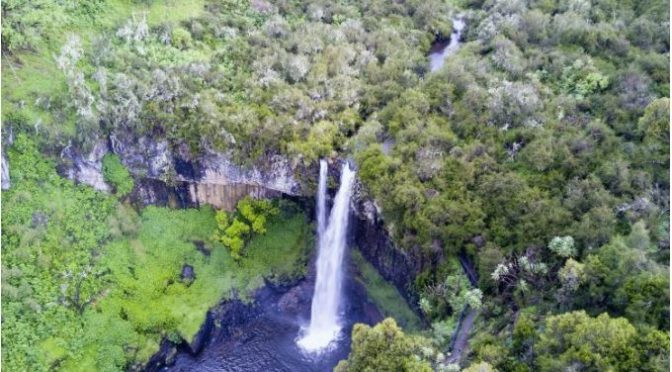
-With a total height of 273 m. It occurs in three steps of 117 m, 26 m and 130 m. Karuru waterfall

Zaina –

https://kenyatalk.s3.amazonaws.com/2015/04/71535_c7e8b4faff45d70b81abaa49cc43c6aa.jpg

Ragia no. 18 and 17

Gura Giant Falls at 305 m

Home

“Everybody’s talking about people breaking into houses but there are more people in the world who want to break out of houses.” -Thornton Wilder, writer (17 Apr 1897-1975)

Kenya has a rich repertoire of things one can do outdoors. There are attractions for the sportive kind looking for outdoor adventure, there are luxury safaris for those seeking less vigour. Besides, it is endowed with fine weather all year round. Be it backpacking, riverine walks, undulating hills, horseback rides, sunrises and sunset, bird – watching, swimming, nature walks, cycling, game drives or wilderness trekking, sandy beaches,  a beautiful of landscapes, birds, plants, and fascinating cultures  Kenya has it all.

If you are an outdoor enthusiast or need an occasional one off outdoor excursion for a new experience, this website will guide you on how to get there. You will find one day excursion, longer excursions require camping or hotel lodge and mostly budget travels

But perhaps your fancy is not in our list. In that case feel free to send us a word and we shall do a research for you.

But don’t take my word for it. Visit the places and try them out.

Where the services are offered by the government, they are quite affordable. Moreover you don’t need to wait until you can make a large group of friends. There are many groups organising schedule excursions around the country. You only need to search online and join in but read the reviews of those who have used them.

But don’t take my word for it. Visit the places and try them out.

Ragia forest

Ragia Forest – Sasumua River Hike

Location Njabini
Starting Point Ragia Forest Gate
Ending point Ragia Forest Gate
Walking Duration 6 hours
Terrain Slippery animal trails through thick bamboo forest
Difficulty Moderate.
Elevation Lowest: Highest:

The objective of this hike is to traverse the bamboo section of Ragia forest, and descend to then ascend from the deep valley of the Ragia two waterfalls number 17 and number 18.

The Elephant
A distant vie of Elephant hill from Sasumua

The Ragia forest trail may start from Ragia forest gate or from the Sasumua dam depending on the r
oute one takes from Njabini. You walk on a motorable road along the fringes of Sasumua Dam (that supply’s water to Nairobi), from where you will be treated to spectacular view of elephant hill.

Bamboo trail

About a kilometre from the dam, the trail abandons the motorable road and diverts into the thick bamboo, where you try to make out animal trails until you reach the clearing marking the water pipeline wayleave. Your struggle with the bamboo abates briefly until suddenly the guide turns left into the bamboo again and the struggle resumes but abruptly ends as the trail deeps as dramatically as the bamboo gives way to a rain forest.

From boots to butts

Two metre drop into the Sasumua River

During the rainy season the place can be serious slippery and many a hiker gives up using boots and reverts to butts. As the roar of the waterfall assaults your ears, the trail drops vertically 2.5 metres into the Sasumua River from where you make a short but exiting riverine walk up to the magnificent Ragia waterfall (waterfall 17)

You camera comes handy on the centre rock.

Having closer look

Your journey back is as dramatic. Where gravity aided the descent it thwarts the ascent. Butts are replaced by knees and hands (sometimes ladies remember they haven’t paid the manicurist for the last visit). Once you get to the way leave, you decide whether to proceed to waterfall 18 or back to the gate.

The crossing

Getting There

Public means: From Nairobi, take Njabini matatus at the junction of Keekorock road and the Nation House roundabout. Alight at Njabini town. At the Njabini matatu stage you will easily negotiate for a Matatu to Sasumua.

Private means: Drive towards Njabini and take a right turn just before the river sasumua bridge. Drive four kilometres to the forest gate.

Entry charges:

Category Charge (KSh)
Residents 200
Non Residents 600
Guide fees: 2,000 (every 10 pax or less)
Armed escort 3,000.
Camping

Guide

Local community organisation,

Kenya Forest Service

Make prior arrangement

Kijabe Hill – Kinari Ridge


Location Mai Mahiu/Longonot
Starting Point Mai Mahiu – Longonot road
Ending point Soko mjinga or Flyover
Walking Duration 9-10 hours
Terrain grazing tracks
Difficulty Moderate
Elevation gain 650m

The objective of the hiker is to traverse the section between the old to the new Nairobi-Nakuru highways. The hiker will go up Kijabe hill, then down Kijabe hill and then up the Kinari ridge and onward to the New Nairobi-Nakuru highway. This hike is ideal for a moderately paced hiker. A mix of slow and moderate speed hikers on this hike always leads to hikers crossing the notorious Kinari forest at dusk which is not advisable

The trail follows the Kijabe hill trail, as described in this post, up to the second crossing of the railway line. (the Lunatic express meadres round the hill)

The Lunch Dome

To recap, the hike starts 9 km form Mai Mahiu just after the conspicuous IDP settlement. Starting at an altitude 2010masl, the  hiker trudges steadily up hill for two to three hours to be at the peak, that is 2659masl. After resting at the peak and doing what hikers do on peaks, you start your descent down the eastern slope. You walk past the place where the paragliders launch their escapades, into and past the farms and homesteads, then into the forest reserve again, and march on to a point near the railway line for lunch. In total you will have dropped down 467metres to 2192asl.  If your timing is good, but it won’t, you will have lunch under some trees as you rest and re-strap your boots. After lunch you walk downhill a few metres to the railway line then walk northwards along it up to two hundred metres off the station. After stopping for a breather it is time to tackle the Kinare ridge.

http://1.bp.blogspot.com/-9OPDMXLVCmw/UmE8xOWuWtI/AAAAAAAABXM/Ao59SvepRtc/s320/DSC02650.JPG
Overgrown bush over the trail
Sunset through Kinari cypress forest

During the dry season the trail is easily visible. But during the rainy season the bush quickly reclaims territory and the hike is more like a test of wits between bush and man.  Make you’re your way through the barely discernible grazing tracks until the path opens to the rush expanses of Kikuyu grass. Cross the grass and into Kinare forest and on to soko mjinga or flyover.

Weather allowing you will be treated to a spectacular sunset on the escarpment before heading to soko mjinga for roast maize. Beware that the place is not called soko
mjinga for nothing


Requirements
Guide fee
Forest charges

Guiding
KENVO

http://4.bp.blogspot.com/-Gz6eg_N64yw/UmE9lnyinMI/AAAAAAAABYU/b5nUa4MMPXo/s320/DSC02660.JPG

Kijabe Hill


Location Maĩ Mahiũ/Longonot
Starting Point Mai Mahiu – Longonot road
Ending point Mai Mahiu – Longonot road
Walking Duration 5 hours
Terrain Grassy uphill and motorable road
Difficulty Easy
Elevation gain 650m over 3km

1Kijabe Hill seen from the Mahi Mahiu Naivasha Highway

Kijabe hill is the second most salient feature north of Mai-Mahiu (Maĩ mahiũ) – means hot water. (It is important to get it right because a change of vowels can give the word completely different meanting). The objective of the hiker is to get to the top of the hill and over the other side then return to the Mai-Mahiu-Naivasha road. The distance to the peak is about 3.2 km, which should take the novice hiker between three and four hours.

The hike starts 9km from Mai Mahiu a point that is almost halfway to Longonot town. The starting altitude is 2010masl and hikers take a northerly direction on a trail that climbs straight and steady until the railway line. This maybe a good place to pause and take stalk of where you have come from as you sip some water and energise. The trail then changes direction north east and the gradient increases somewhat. The hiker is advised to stick to the path charted by the guide as gullies, from erosion and tectonic earth movement, are deep and treacherous. The thorn bushes do get quite shot but arrogant after this point attacking the ankles and lower legs mercilessly. But it is not all gloom because while it does not save you the cost of a tattoo, it means you are too busy evading the pricks to notice the tedious climb. As such you barely notice time pass as you get to the rocky part where the gradient ratchets a notch higher, hiding the true peak and thus making one believe that over those rocks is the peak.

After this false peak the climb is steady to the true peak, at 2659masl.

A brief rest is well earned. Unfortunately up that hill there is nowhere to hind from the vagaries of the weather, be it the chill of July, the windy March or the sun. However you are well rewarded by the view all around you as you soak in the beauty of the surrounding country. But what catches the eye of the hiker is the hiking opportunities displayed all around:

There is Suswa to the South, Longonot to the West, Elephant hill to east and the ridges of the Eastern Escarpment of the Great Rift Valley Kinare, Kiharu, Nathan’s, and William’s hill)

As you enjoy the peace up there and the apparent calm below you cannot help but marvel at the IDP camps down below and the resilience their gallant dwellers. Theirs is an island of green tall trees in the middle of stunted grass all round.

The return journey is quick two hours downhill. You the walk eastwards down the hill, cross the railway line, and trudge on to the abandoned old Kijabe town. From here, walk another one hour west along a motorable road until you get two the highway about four kilometres from where you stared.

If you are using private means, the vehicle will be waiting here. Otherwise, you should easily hail down a Matatu to Mai Mahiu for late lunch.

Requirements

Guide fee

Guiding

Local Community